
ibcsr.org

  • Increase font size
  • Default font size
  • Decrease font size
Institute for the Biocultural Study of Religion

Is atheism linked to intelligence?

E-mail Print

Not so long ago experts predicted the imminent collapse of religion in modern western cultureSocial_Psychology_Quarterly_Cover_March_2010. Religion – often synonymous in these discussions with superstition, magic, and delusion – would at last give way to the autonomy of human reason and the power of the experimental method of natural investigation. But something happened on the way to religion’s funeral. People kept on believing. Recent neuroscientific and evolutionary research has suggested that either many of the hallmarks of religion are, or are byproducts of, adaptations that helped our earliest ancestors survive. The more that has been learned about the way our brains and our genes function it is the evolutionarily novel lack of religious belief and practices that is truly puzzling. A recent study by Satoshi Kanazawa provocatively titled, “Why liberals and atheists are more intelligent,” suggests that people that are more intelligent are able to overcome the limitations of our evolutionary past. In other words, the smarter you are the more likely you are to be an atheist.

Read more...
 

Risk preference and religiosity

E-mail Print

In most western societies the choice not to belong to a religious community, if even in a minimal way, comes with JSSR_Cover_March_2010considerable risk. In cultures dominated by the Abrahamic monotheisms (Judaism, Christianity, and Islam) non-affiliation and nonparticipation are obviously “risky” both in terms of interpersonal relationships here and now and in terms of the ultimate destination of the soul. Not belonging to a religious tradition and community makes one an “outsider” and thus not easily associated with or in many cases not easily trusted. Add to this the perceived threat of eternal damnation and the risk can seem to outweigh the benefits of religious participation greatly. In other words, as Pascal famously argued, religion is a good bet. As plausible as it might seem that the irreligious are generally more inclined to take risks, an important question is whether this pattern is a universal human trait or if instead it is simply an aspect of the culturally specific western religious traditions and the cultures they form such an important part. In other words, is it similarly “risky” to avoid religion in a culture where the dominate traditions are less concerned with exclusivity of belief, practice, or community identity?

Read more...
 

Self-transcendence enhanced by removal of portions of the parietal-occipital cortex

E-mail Print

For many years, research has pointed to specific neural pathways as the presumed locus ofNeuron_65 spiritual thoughts, feelings, and experiences. Famously, studies have shown similar patterns of brain activation in Buddhist meditation and Christian contemplative prayer for example. The majority of this research relies on a simple correlation between observed neurological activity and reported experience. A new study adds to the emerging picture by comparing a measure of spirituality, self-transcendence, both before and after surgical manipulation of the complex architecture of the brain. In fact, for some cancer patients brain surgery led to a spiritual awakening.

Read more...
 

The human drama behind The Origin of Species

E-mail Print

Some figures become so iconic, so legendary, that they begin to take on the characteristics of an idea rather than a person. MereCharles_and_William_Darwin mention of the name of Albert Einstein for example often brings to mind simply the very idea of genius or perhaps maybe an image of his famously unkempt hairdo. The man himself lies somehow hidden behind his equations. He has become largely the stuff of the popular imagination about his ideas and thus somehow both more and sadly less than human. This is how it is for all those who make a lasting contribution to the long march of human self-understanding. Thinkers, inventors, prophets, and poets all risk being lost as individuals by the very profundity of their contributions. Few have suffered this fate more than Charles Darwin, a man whose ideas have inspired new frontiers of human learning and incited some of the deepest feelings of distrust, disgust, and hatred. The new film, “Creation: The True Story of Charles Darwin,” attempts to go behind the theory and reveal the theorizer in all his conflicted genius and above all his love for the truth and his family.

Read more...
 

God: Produced or perceived by the brain?

E-mail Print

If our brains have evolved to help us interact with our world, and if many of us report “interacting” with God or other religioCogn_Process_Coverus entities, then doesn’t that suggest that such beings are real and that just as we have developed the capacity to perceive the colors of a rainbow we have a mental capacity to perceive the divine? It is a natural enough notion, but on closer inspection it is complicated by multiple levels of scientific and theological obstacles. A recent article from the journal Cognitive Processing reviews research on the neural correlates of religious experience. Two neuroscientists, identical twins Alexander and Andrew Fingelkurts, authored the paper entitled “Is our brain hardwired to produce God, or is our brain hardwired to perceive God? A systematic review on the role of the brain in mediating religious experience.”

Read more...
 

Religious and mystical experiences common among Americans

E-mail Print

While predictions of the imminent death of religion in an increasingly “secular” world oftentransition_page_prayer_3 sound quaint, if not downright out of touch, profound religious experience can still seem like the purview of a fringe minority. After all, being “born again,” or achieving “mokṣa” (liberation) are not exactly everyday experiences, even for those who say they have had them. Nevertheless, a new survey by the Pew Form on Religion and Public Life finds that nearly half of all Americans have had what they consider a “religious or mystical experience,” over twice as many as in 1962.

Read more...
 

Public opinion and the “conflict” between religion and science

E-mail Print

BibleandsciencelargeThe United States is a leading power in science and engineering, but it's also far more religious than most industrialized nations. This means that there is ample opportunity for conflict between the worldviews of religious traditions and science. While most of the media attention devoted to religion and science centers on the supposed conflict between them, a new Pew Research Center poll finds that “those who are most religiously observant (as measured by frequency of worship service attendance) are the least likely to perceive a clash between faith and science.” Those with no religious affiliation are more likely to see a conflict between religion and science.

Read more...
 

Belief in God linked to suffering

E-mail Print

There is no denying that terrible things happen in the world. From the horrors of the Haitian earthquake to the near constant hum Cathédrale Sainte Trinitéof smaller scale but equally tragic news, all too often we are faced with what for many theologians is a daunting problem. How can it be affirmed that there is an all knowing, all powerful, and compassionate God when so much suffering takes place in the world? While theodicy (the attempt to reconcile the "facts" of suffering and evil with traditional theism) is among the more commonly discussed theological issues in the public sphere, it does not seem to have much impact on religious belief. It might reasonably be assumed, for example, that those of us who have the most experience of suffering, either natural or moral (i.e., caused by an active agent), would be least likely to believe in a God who knows bad things will happen, could stop them from happening, cares deeply for us, and yet still somehow lets tragedy strike. As reasonable as that might sound, researchers have recently found that just the opposite appears to be true. Those who suffer most believe in God more than those who experience less suffering.

Read more...
 

End-of-life care: is spirituality important?

E-mail Print

Worried patientIt’s no secret that spiritual and religious issues are especially important for those facing terminal illness or death. In fact, some experts think that the ways that patients’ religious and spiritual needs are addressed can have far-reaching practical consequences in medical settings. A recent study led by researchers at the Dana-Farber Cancer Institute suggests that providing for patients’ spiritual needs is an essential part of end-of-life cancer care, and that terminal patients who feel those needs are being met receive more hospice care and opt for fewer aggressive or invasive treatments than other patients. Their overall quality of life, the researchers claim, is also higher.

Read more...
 

A look back at 2009

E-mail Print

2009 was a big year for science and religion with evolution claiming the biggest headlines.CMHRimageThe 200th birthday of Charles Darwin caught the public’s attention in February and the 150th anniversary of The Origin of Species in November brought debates over evolution and religion into prominence worldwide. While issues around evolution and Darwin received most of the public attention, scientific research on the biocultural components of religion continued at a dizzying pace.

Read more...
 

Wallace's Contemplative Science

E-mail Print

Buddhist scholar, B. Alan Wallace's Contemplative Science: Where Buddhism aBook_Jacketnd Neuroscience Converge (Columbia University Press, 2007) is an attractive read for anyone interested in neuroscience, consciousness, psychology, Buddhism, or religious studies. Educated in the West and having studied under H.H. the Dalai Lama in the East, Wallace represents a unique type of interdisciplinary scholar. He has written many books exploring the interface of consciousness and Buddhism, translated and interpreted for many Buddhist contemplatives and scholars, and most recently established the Santa Barbara Institute for Consciousness Studies.

Read more...
 

Parkinson’s and religious semantics

E-mail Print

INSWhen we hear only one word of a pair such as "holy" or "spirit," the other word tends to spring to mind because the words are associated in semantic networks in our brains. Even if we don't attach any specific meaning or importance to these "religious" words, we know that they belong together. These kinds of connections between words and the concepts they represent are an important part of what makes the lived experience of religion possible. It is one of the ways we form the complex associations that make up religious beliefs and practices. According to a new study, patients suffering from Parkinson’s disease were found to have difficulty recalling these connections compared to a control group, and this is leading to some interesting conclusions about how religious semantic networks function.

Read more...
 

Toward an anatomy of religiosity

E-mail Print

While media excitement about the supposed discovery of a single “God module” in the brainBrain Gears has rightly followed scientific consensus and cooled off considerably, the more general idea that religious thoughts, feelings, and experiences are realized by specific regions of the brain remains a suggestive hypothesis. For example, if variations in the density of brain regions can be associated with memory loss, then why wouldn’t we see a similar correlation with religion? Not surprisingly, researchers have recently found links between religion and regional cortical volume.

Read more...
 
  • «
  •  Start 
  •  Prev 
  •  1 
  •  2 
  •  3 
  •  4 
  •  5 
  •  Next 
  •  End 
  • »


Page 1 of 5

IBCSR Research Review

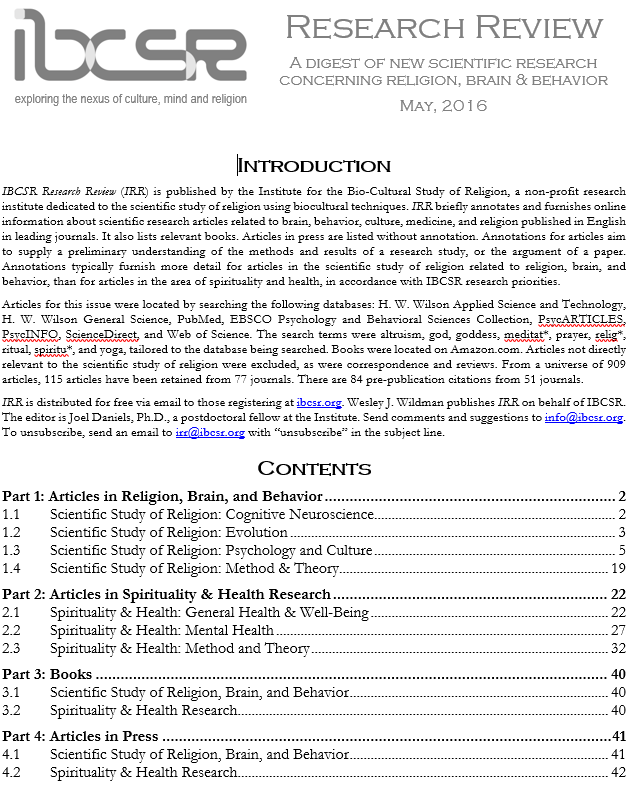
This periodic email newsletter alerts you to recent scientific publications in research areas related to religion, brain, and behavior.
Name:
Email:

Events

<<  March 2010  >>
 M  T  W  T  F  S  S 
  1  2  3  4  5  6  7
  81011121314
151617181921
22232425262728
293031    

Who's Online

We have 2 guests online

Vistors

mod_vvisit_counterToday27
mod_vvisit_counterYesterday37
mod_vvisit_counterThis week250
mod_vvisit_counterThis month763
mod_vvisit_counterAll13937

Newsflash

IBCSR is pleased to announce the publication of The Neuroscience of Religious Experience (Cambridge University Press, 2009) by Patrick McNamara. This volume "focuses on the neurological aspects of religious experience" and presents an "evaluation of the latest and best-established facts concerning religion and brain." For more information see here.